In 2025, the 1998 song "Olson," by Boards of Canada was played using the 1962 Harmony Compiler on the world's last running 1959 DEC PDP-1.
Boards of Canada "Olson" playing on the PDP-1.
The PDP-1 was never intended to produce audio, much less make music, long predating sound cards or MIDI ports. It does however have six "program flags," which are flip-flops wired to six light bulbs on the control panel. A CPU instruction provides the ability to turn these light bulbs on or off via software.
These bulbs were originally intended to provide program status information to the computer operator, but Peter Samson repurposed four of these light bulbs into four square wave generators (or 1-bit DACs, put another way), by turning the bulbs on and off at audio frequencies with his Harmony Compiler software.
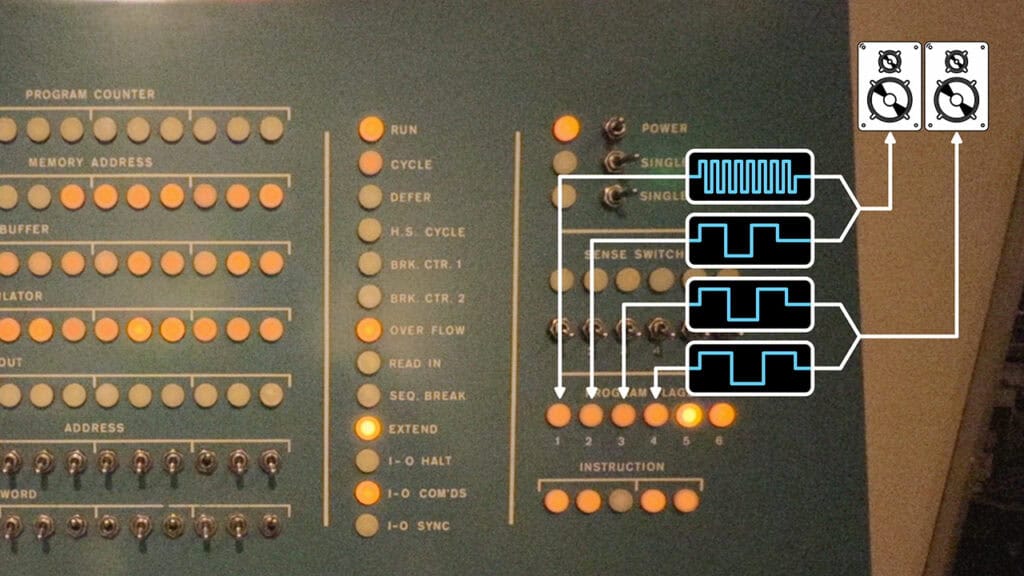
Waveforms of the four voices playing "Olson."
Four wires are attached to the signal lines for these light bulbs. Four resistors are used to downmix these four signals into stereo audio channels and are combined with four capacitors to create low pass filters to cut out the buzz of the computer noise and soften the square waves. A connected vintage HeathKit stereo amplifier then drives speakers mounted on the wall behind the PDP-1.
For Peter's initial PDP-1 implementation at MIT, prior to using the program flags, he added four flip-flops to the machine specifically for playing music, something easy to do in that research environment.
Late at night in 1962, Bach could be heard playing through those four lightbulbs in an MIT research lab, as student and "unauthorized user" Peter Samson developed his Harmony Compiler.
Though the Harmony Compiler was originally developed to play the 1700s baroque organ works of Bach with four-part harmony, the synth melody and drone of “Olson,” combined with its lack of percussion, make it an exceptional fit. While this may seem coincidental, surprisingly there is an interesting lineage to be found between them.
The baroque organ pioneered the use of sustained, drone-like textures as musical foundations. The ability to hold multiple notes indefinitely while layering melody above created a spatial, immersive quality that laid the groundwork for ambient electronica's musical aesthetics.
Peter's pioneering work in computer music represents a bridge between the baroque organ's architectural approach to sound and the hauntological electronic textures that would later define Boards of Canada. Reproducing Bach's polyphonic organ works within the PDP-1's severe computational constraints forced elegant solutions that enabled and codified the “melody-plus-drone” structure commonly heard in more modern digitally synthesized music.
Peter didn't stop with the PDP-1 though, continuing to pioneer digital music synthesis on later PDP machines. When a PDP-6 arrived at MIT, its increased speed allowed Peter to write a version that supported six voices, tapping the Memory Indicator lights. He later wrote another version for the System Concepts PDP-15 clone, known as the SC-15.
His work in this field culminated with his development of the Systems Concepts Digital Synthesizer, better known as the "Samson Box," the most advanced digital synthesizers of its day. It was first presented in 1974 at the Computer Music Conference at Michigan State University. In 1977, the Samson Box was installed at Stanford's Center for Computer Research in Music and Acoustics (CCRMA) facility, a leading academic center dedicated to computer music and digital audio research.
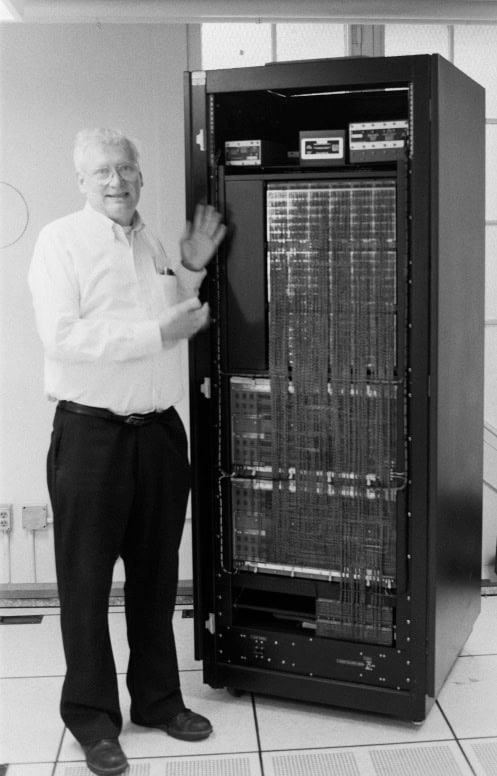
Peter Samson stands next to the Samson Box at CCRMA. (Source: Life and Times of the Samson Box)
The influence of Samson's approach extended through the Samson Box as it found use in educational media production.
These educational soundtracks, whether created on the Samson Box, or the 1970s synth work heard in educational films produced by the National Film Board of Canada, converged on a remarkably similar aesthetic: otherworldly timbres built from simple waveforms, and that particular quality of institutional nostalgia that would later heavily influence Boards of Canada.
The Samson Box can be heard in the music of Michael McNabb in the 1979 NASA film Mars in 3D. Boards of Canada's "Dandelion" carried this tradition forward.
The Samson Box heard in the music of Michael McNabb in the 1979 NASA film "Mars in 3D."
Board's of Canada "Dandelion."
"Olson" primarily consists of a melody over drone chords, with a piano outro. To work within the PDP-1's four square wave generators, one voice is dedicated to the melody, and the other three are used for the high, middle, and low notes of the drone chords. All four voices are then repurposed for the eight measure outro.
The Harmony Compiler defines its own domain-specific language for encoding the score of each voice of a song. The middle note of the drone chords is the simplest voice, so let's look at that as an example. In the transcription below, the score is seen in white, and comments describing each line are in green.
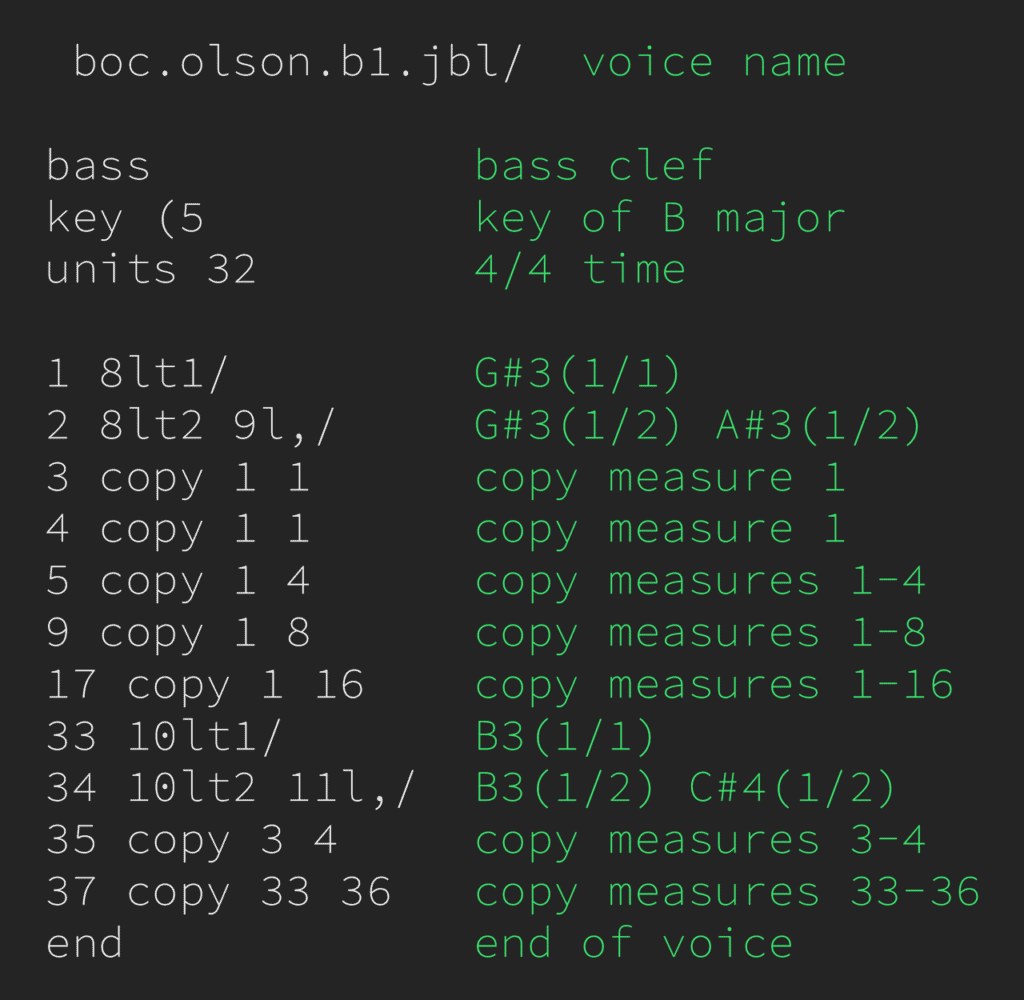
"Olson" score for the middle note of the bass drone chords.
In the line "2 8lt2 9l,/", the "2" specifies this is the second measure. The first note of the measure, "8lt2", is in the 8th position of the staff (G# in this case). The "l" indicates the note is played legato, flowing seamlessly into the next note, and "t2" indicates the duration is a half note. The next note is defined as "9l," indicating an A# legato note, with "," repeating the duration of the prior note. The end of the measure is indicated with the "/" character.
When encoded onto paper tape, the voice is broken into two sections: notes and bars. The notes section contains the notes of the measures, with the bars section containing offsets to the start of measures in the notes sections. By using the "copy" operation, we avoid duplicating data in the notes section.
The efficiency provided by the copy operations allow the entire song to fit in only 603 bytes.
One complexity in transcribing "Olson" is that it is tuned about 50 cents sharp from standard tuning. For example, a C note sits about halfway between C and C# in standard tuning.
However, the CHM PDP-1's CPU coincidentally runs about 6% slower than spec, resulting in notes being played at about a 6% lower frequency. By transposing the entire transcription up by a semitone (e.g. C becomes C#), this speed discrepancy provides a tuning fairly close to the song's original tuning.
In the transcription this was done by manually changing each note. In hindsight, the Harmony Compiler provides a simpler way to do this, where the transposition command "up 1" would have had the same effect with less work.

The notes and beginning of the bars section of the middle drone voice.
Using holes in paper to encode music has historical roots. The "Pianola" player piano was doing this in 1896. In the case of the PDP-1 this is done digitally, with each note, bar offset, and related metadata stored as 18-bit words.
The Harmony Compiler works in two phases. The first phase converts the score to an "intermediate tape," containing the notes and bars sections of each voice. The second phase then compiles the intermediate tape to an internal format that can more efficiently be played back on the PDP-1 by the same software.
The first phase can be run on just about any modern computer. First the scores are converted from ASCII to the FIO-DEC character encoding. Then the SIMH PDP-1 emulator is used to run the first phase of the Harmony Compiler and produce a file containing the intermediate tape.
The intermediate tape file is then punched to physical tape. Thanks to the robustness and longevity of the RS-232 protocol, using a modern laptop to drive a 42-year-old tape punch requires only a USB-RS232 adapter.
Punching "Olson" onto paper tape.
With the tape punched, "Olson" is ready to be loaded into the PDP-1, and played on a machine born over a decade before the song's original composers.
We demo the PDP-1 at CHM on the first and third Saturdays of each month at 2:30 p.m. and 3:15 p.m. (Check here for the latest schedule.) Just ask one of the volunteers, and we'll be happy to load up the "Olson" tape and play it!