We're living through a boom in artificial intelligence. But, many people may not realize that there have been AI booms—and busts—before. Is it different this time? CHM sought to find out by inviting three AI pioneers who have each navigated distinct eras of AI innovation for a discussion on October 7, 2025. The CHM Live event, “This Time It’s Different: AI Startups Across Three Generations,” was made possible by the generous support of Mark and Mary Stevens.
Marc Weber, a CHM curator and director of the Internet History Program moderated the discussion. He noted that AI busts in the past made the term itself toxic even as startups and companies were still using the technology, and only with more recent hype has AI become popular again.
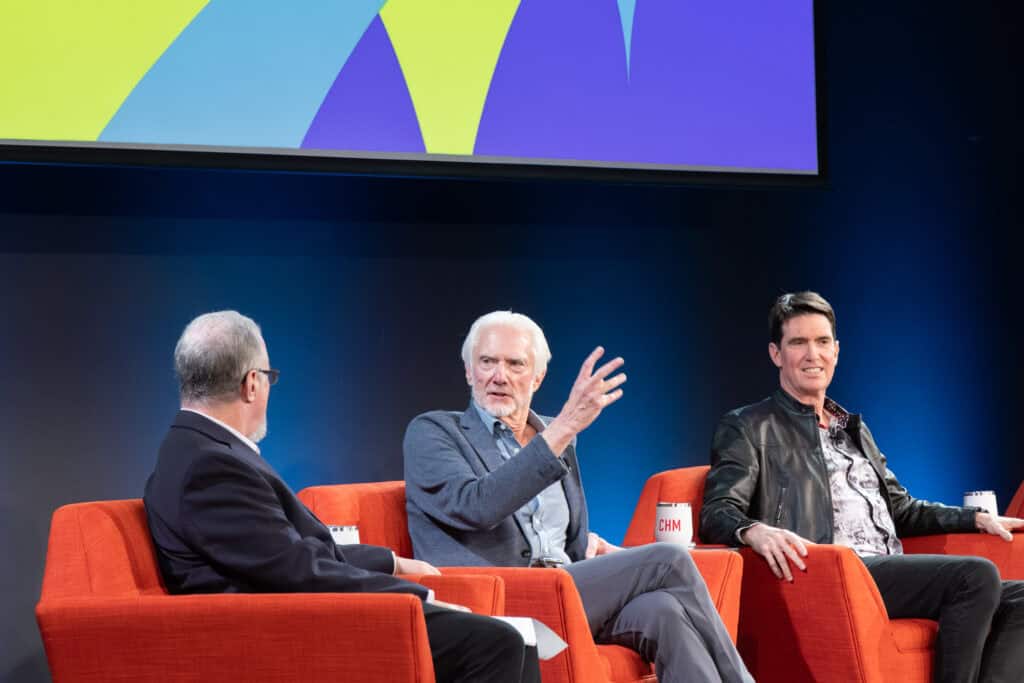
Jerry Kaplan (center) makes a point. Marc Weber is at left and Adam Cheyer at right.
AI Company Founders Jerry Kaplan, cofounder of Teknowledge, an AI company that helped ignite the 1980s expert systems boom, was one of the first to earn a PhD in artificial intelligence, and the company he founded took the work he and others were doing in expert systems at Stanford and sold it to corporations to solve problems. But, he notes, the business model was based on incorrect assumptions—just like the AI industry today.
Representing the next generation, Adam Cheyer, cofounder of Siri, explained that they didn’t pitch their company as AI. They called Siri a “do engine” to distinguish it from a search engine. It could combine knowledge and action to serve as a virtual assistant. With its “ecosystem” of businesses partners, for example, Siri could call you a cab or buy movie tickets. Cheyer credits Steve Jobs, who bought Siri for Apple in 2011 and called it an AI company publicly, with reinvigorating the field.
Director of MIT’s Computer Science and Artificial Intelligence Laboratory (CSAIL) Daniela Rus is also the cofounder of AI startup Liquid AI. The company’s AI model operates on physical laws rather than the statistical basis of LLMs (large language models). It’s inspired by nature—a worm with a relatively small number of neurons and synapses that are remarkably powerful and energy efficient. Where a classical AI model needs about 100,000 neurons to keep an autonomous car in a lane, for example, with Liquid AI, you need only 19. And the model can also explain how the vehicle makes decisions and gains skills, allowing for generalization and application to different environments, which classical AI transformers are not good at. Further, the energy savings is significant because it is 1,000 times more efficient. It could, Rus said, democratize AI.
Daniela Rus explains how a new model can open AI tools to everyone.
Jerry Kaplan believes that expert systems technology was not good enough to do the things it promised to do and that’s why it collapsed. He sees the ambitions of his era’s academics in AI as part of a continuum of people’s fascination with using technology to enhance or serve humanity, from Frankenstein to today’s dream of artificial general intelligence.
Cheyer was looking at the problem of how to make language practical. He says that Siri shocked the world when it first came out.
Adam Cheyer describes how Siri had to make sense of language.
One of the big innovations with Siri was doing language well in a conversational way and executing on actions—what we would call agentic AI today.
Both Cheyer and Kaplan believe that the timing of a tech innovation is what makes or breaks it. Rus argued for the value of technological entrepreneurship that brings new ideas and new capabilities to the world over timing. But, when she recalled that it’s often very hard to get the rest of the world to back new ideas she came around to agree with her co-panelists that timing is critical.
So, is today’s AI boom different than previous booms? Kaplan says, “It’s different just like last time.” He believes this bubble will burst, with dire consequences for the entire society.
Jerry Kaplan predicts the AI bust.
What effect will today’s AI revolution have on jobs? Kaplan believes it will have the same effects as other technological advances that substitute capital for labor—it will change the nature of work. Some will lose their jobs, but new kinds of jobs will arise. Rus noted that her MIT colleague, economist David Otter, has done research showing that more than 60% of what people do today did not exist before 1948. No one foretold the rise of the service industry. She believes there will be a flurry of economic activity around AI that will draw all kinds of people with different skills and talents into the industry. It’s critical, she says, that the public begin to develop some AI literacy and empower themselves by understanding what aspects will affect your role.
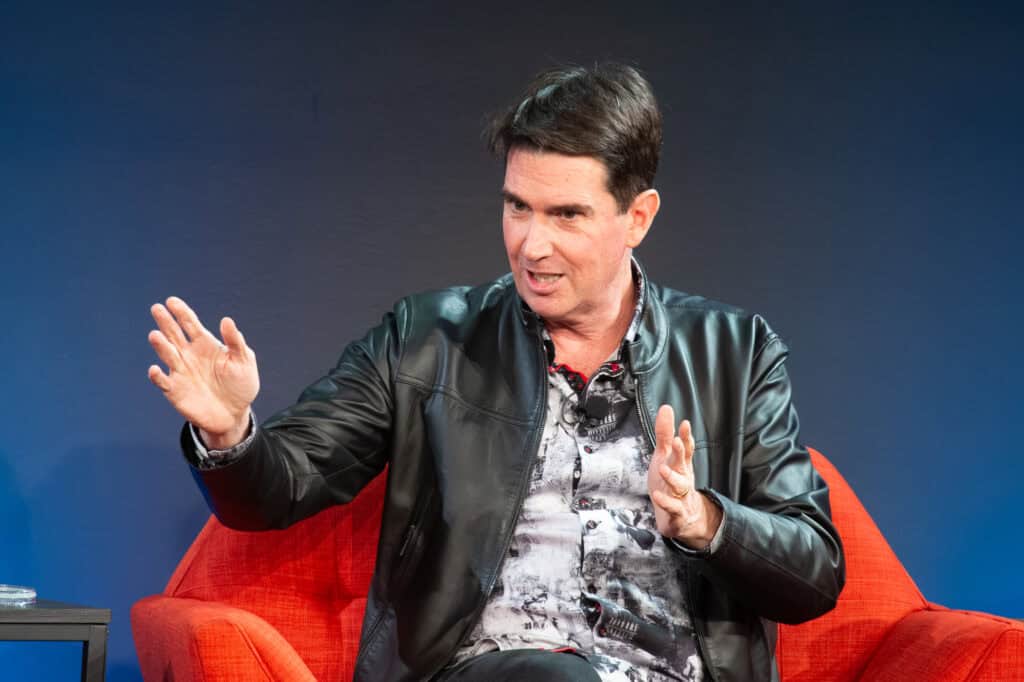
Adam Cheyer describes the power of AI.
Adam Cheyer notes that AI is already solving problems, including 50-year-old math problems and exponentially advancing our understanding of protein folding, critical for drug discovery. He acknowledges that AI will also cause problems, but overall he’s optimistic it will solve a broad range of challenges. It is, he believes, the most powerful tool humanity has ever created.
For young people aspiring to be founders of new AI companies, Cheyer and Kaplan urge caution. Don’t do it, they say, just because you want to be an entrepreneur or to make money. Do it because you’re passionate about what you’re creating. Hopefully, aspiring AI founders will take Daniela Rus’ words to heart and recognize both the extraordinary opportunity AI provides to enrich our lives and look after humanity and the planet, and create responsible AI tools that serve the greater good.
This Time It's Different | CHM Live, October 7, 2025
Free events like these would not be possible without the generous support of people like you who care deeply about decoding technology for everyone. Please consider making a donation.