In 1981, a groundbreaking show featured digital art on monitors connected to framebuffers and a computer. This marked the first time digital images were displayed in their native electronic form, a practice that has since become standard worldwide. The exhibition, held at the Association for Computing Machinery’s SIGGRAPH conference in Dallas, was conceived by a small team of tech pioneers who defied all odds to make it happen.
The small team was based out of the Computer Graphics Lab at NASA’s Jet Propulsion Laboratory (JPL) in Pasadena. It included the lab’s manager, Robert Holzman; computer scientist Jim Blinn; systems engineer Julian Gomez; systems engineer Eric Levy; independent artist David Em, who was the lab’s Artist-in-Residence; and James Seligman, Em’s producer.
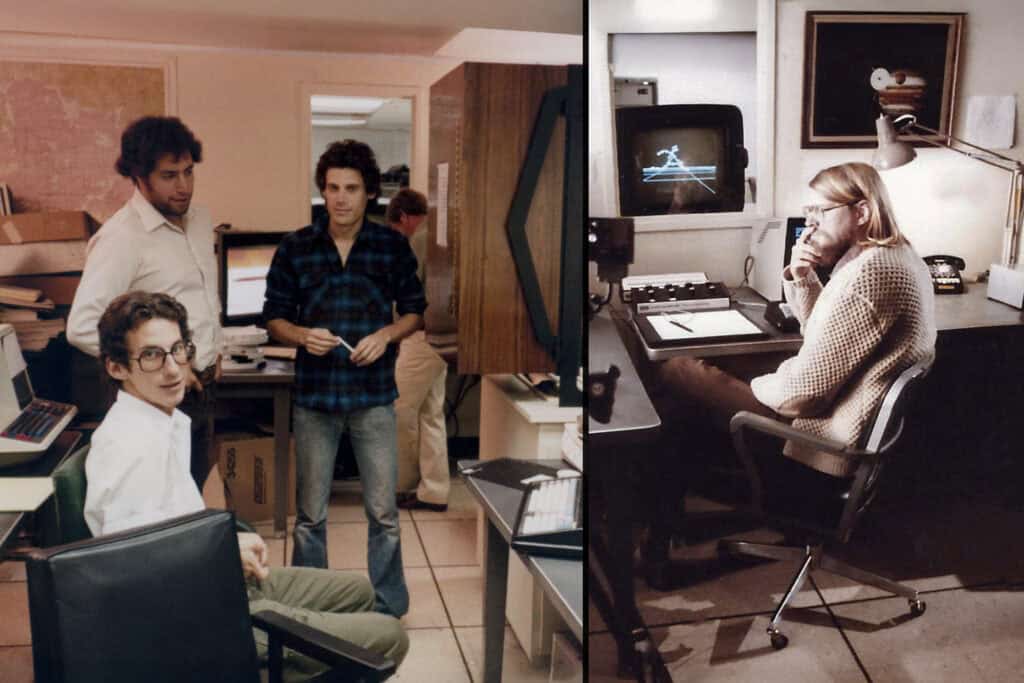
Left image: Four of the key producers of the 1981 Framebuffer Show at the JPL Graphics Lab; from left to right: James Seligman, Julian Gomez, and David Em. Courtesy of David Em, 1981. Right image: Jim Blinn in front of the computer setup in the Graphics Lab, creating simulations of the Voyager flybys. Courtesy of Jim Blinn, 1981.
The digital images displayed were primarily by Em, Blinn, and the New York Institute of Technology’s Computer Graphics Lab (NYIT or New York Tech CGL). The exhibition was viewed by thousands of attendees and paved the way for future purely electronic exhibitions.
While computer-generated art had been exhibited prior to this show, such as at the Howard Wise Gallery in New York (April 1965) and the Cybernetic Serendipity exhibition (August to October 1968) at the Institute of Contemporary Arts in London, the artworks exhibited there, for the most part, were works on paper.
Robert Holzman was not a typical corporate manager; he was an engineer with a background in deep space photography. Holzman’s genius was to hire talented people, then step back and let them do what they did best, while shielding them from the federal bureaucracy at the JPL. He was also a visionary with a passion for the arts. Holzman later married Patric Prince, a key figure in digital art exhibitions throughout the 1980s.
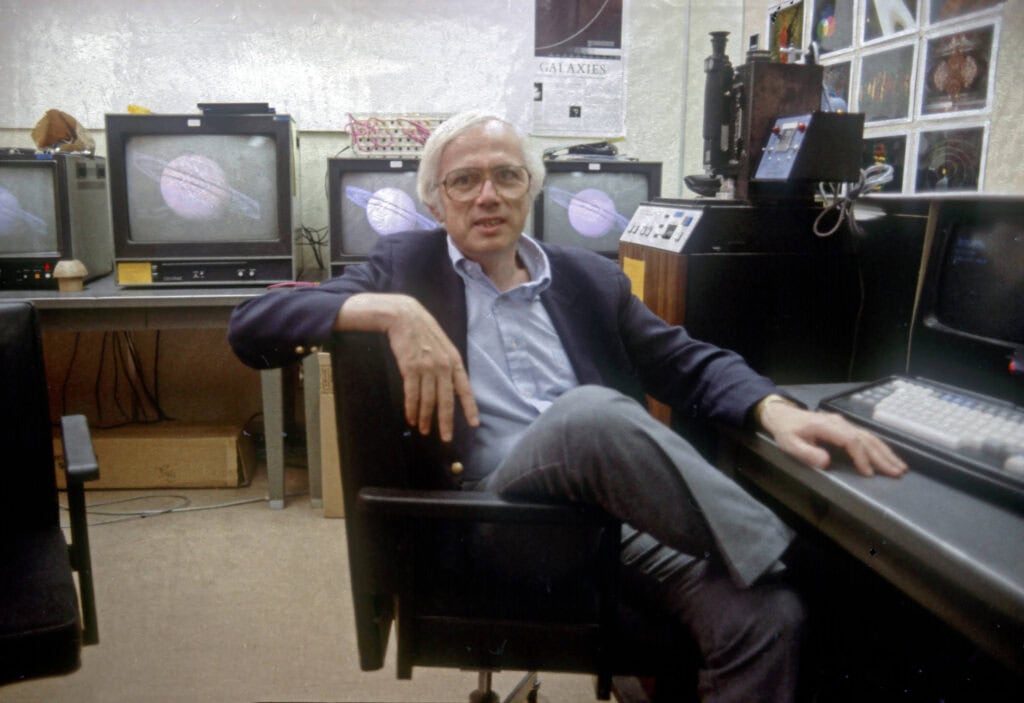
Robert Holzman, the JPL Graphics Lab manager, 1981. Photo courtesy of David Em.
In 1975, Holzman sought funding within NASA to establish what would become the JPL Computer Graphics Lab, a research facility focused on creating deep-space simulations and media for public dissemination. These would eventually be viewed by billions of people worldwide.[1]
Meanwhile, around the same time, digital artist David Em was looking for a high-tech institution in the United States with which he could collaborate to pursue his interest in digital art. He had recently built a framebuffer (the key memory component of graphics cards and GPUs) from scratch; however, he quickly realized that to create the art he envisioned, he needed to be affiliated with a large institution that could provide access to higher-end computer hardware and sophisticated software.
Em contacted JPL and got Holzman on the other end of the phone—shortly after, Em visited Holzman in his office and they spent the afternoon talking about art. As they were wrapping up, Holzman said to Em, “You know, if I ever do get funding, it would be great to have an Artist-in-Residence, would you be interested in doing that?”
About a month later, Holzman secured funding for his Graphics Lab at JPL, and in January of 1976, Em moved to Pasadena; however, it took almost another year and a half before JPL allocated space for the lab on its campus, the machines were up and running, and staff were hired. By the summer of 1977, Jim Blinn had arrived, and shortly after that, Julian Gomez.
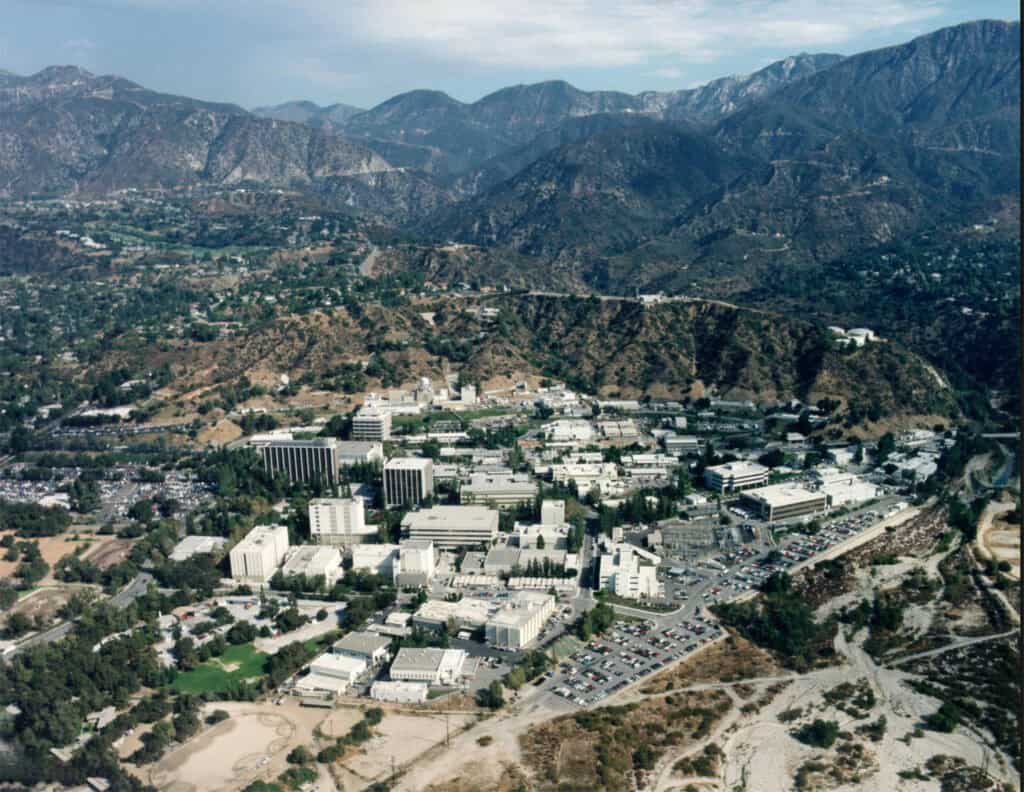
The Jet Propulsion Laboratory main campus, Pasadena, California. The Graphics Lab relocated in the spring of 1981 from Building 264, where all artworks had been created since 1977, to Building 233, where the 1981 Framebuffer Show was organized. Image courtesy of NASA/JPL.
Julian Gomez, who had just graduated from UC Berkeley, served as the Graphics Lab’s technical specialist. He left JPL in 1982 to pursue his doctorate with computer scientist Franklin C. Crow at Ohio State University. Here, he also collaborated with pioneering digital artist Charles “Chuck” Csuri, who was the lab director and head of the Computer Graphics Research Group.
Jim Blinn had recently earned his doctorate at the University of Utah, where he studied in the department founded by David Evans and Ivan Sutherland. Evans and Sutherland also founded a company (Evans & Sutherland, or E&S) that created digital simulations and produced the first commercial framebuffers.
Blinn’s advanced simulation software greatly contributed to the JPL Graphics Lab’s success. During his tenure at JPL, some of his early projects involved creating films simulating the Voyager I and II flybys of Jupiter and Saturn.[2] Blinn and his former mentor, Sutherland, would later both receive prestigious awards for their substantial contributions to the field of computer graphics.
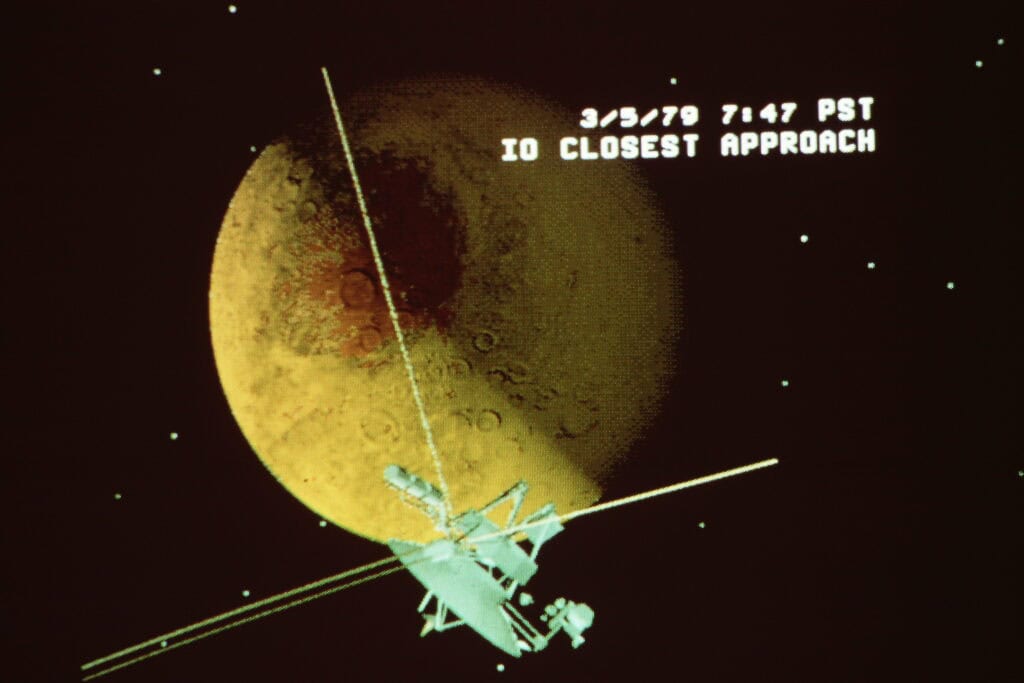
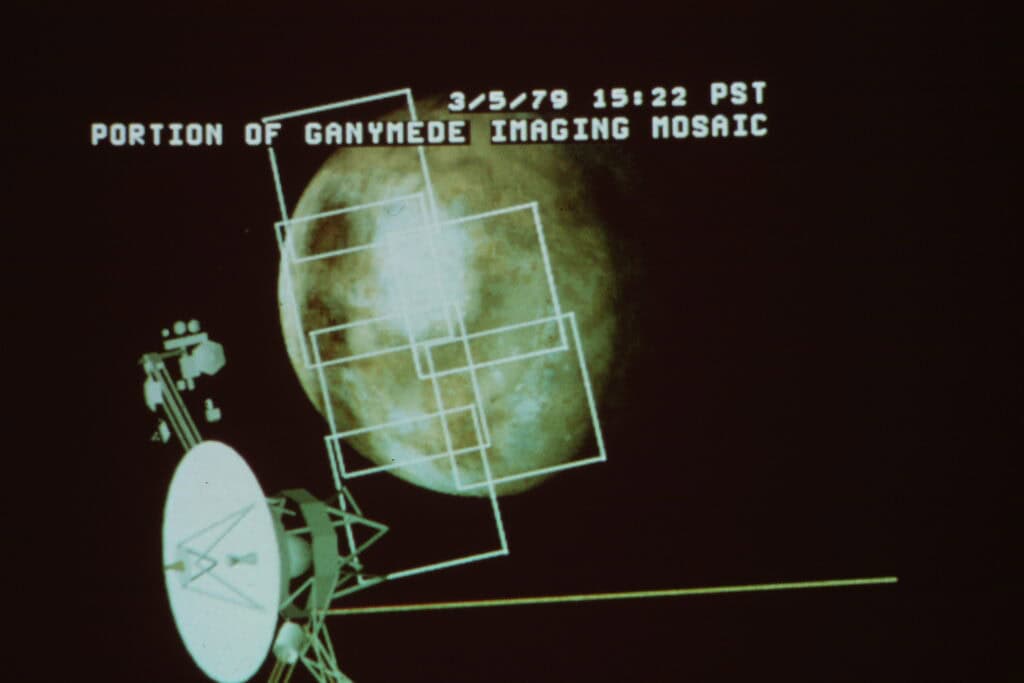
Simulations by Jim Blinn of the Voyager I flybys of two of the moons of Jupiter: top: Io; bottom: Ganymede. Image courtesy of NASA/JPL.
Blinn and Em shared a symbiotic work relationship for more than a decade. Both would often work from 5 P.M. to 9 A.M., once the regular nine-to-fivers had gone home. Sitting in a cold room so the computers would not overheat, dressed for winter, it was almost like working on a space station. While Blinn was developing and improving the software, Em was using it to create art. His work from this period reflects the deep-space atmosphere in which he and Blinn were working.
While using the software to create art, Em would inevitably encounter glitches and would notify Blinn, who would fix them. The first artworks by Em, created with Blinn’s software on an E&S framebuffer in Holzman’s Graphics Lab at JPL, were produced at the end of 1977. Blinn’s software had come a long way by September 1979, with the ability to create three-dimensional virtual worlds on the screen, including texture mapping and matrix transformations. Em was able to create images like Transjovian Pipeline, demonstrating what was technically possible with framebuffers at the time; an image that would become the poster child for digital art throughout the 1980s.
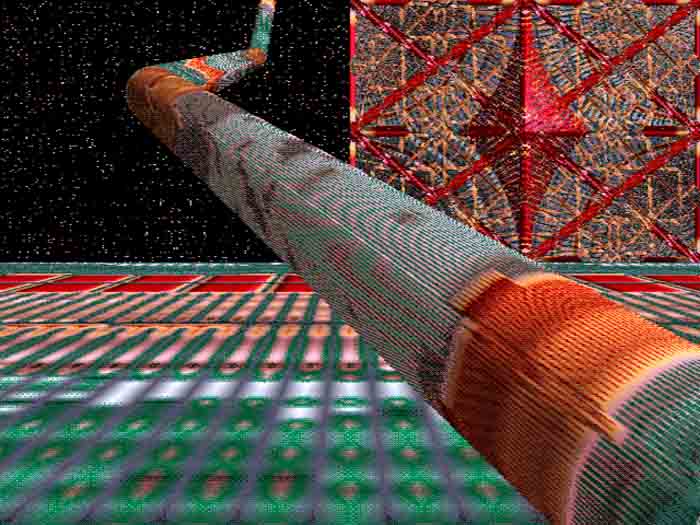
Transjovian Pipeline, 1979, by David Em. A three-dimensional simulation of a world, and one of the artworks cycling on the Conrac monitors at the 1981 Framebuffer Show. This version was recovered from the original pixels on magnetic tapes with the assistance of the Computer History Museum and Jim Blinn in 2021. Image courtesy of David Em.
The team at NYIT that contributed artworks to the 1981 Framebuffer Show was directed by computer scientist Lance Williams, a researcher at the NYIT Computer Graphics Lab, which, like the JPL Graphics Lab, operated both as a research lab and a production facility. NYIT was founded in the 1950s by Alexander Schure, who envisioned creating feature-length animations. Comprised of both computer scientists and designers who collaborated to generate computer graphics, NYIT’s work environment was unique.
In June of 1981, just two months before the SIGGRAPH conference in Dallas, Holzman, Blinn, and Em met in the Graphics Lab to discuss the prospects of producing a framebuffer show. Blinn and Em proposed the project, which they had been contemplating for some time, and asked Holzman to allocate the lab’s resources. If they could pull it off, this would be the first time pixel images were displayed as intended in a public setting—that is, electronically, with direct feeds to high-resolution (at that time) monitors from framebuffers and a computer.
Holzman, who was passionate about the arts, agreed without hesitation—and the project quickly went into high gear. Part of the Graphics Lab team was at the same time preparing a film for the upcoming Voyager II flyby of Saturn (August 8, 1981), scheduled to take place around the same time as the conference.
Precisely how SIGGRAPH, then chaired by Thomas A. DeFanti, was brought on board remains unclear, but someone within the Graphics Lab made the necessary phone call to secure the showroom. James Seligman, with extensive production experience, was responsible for general communication between the team and external collaborators. He was also responsible for writing the press release.
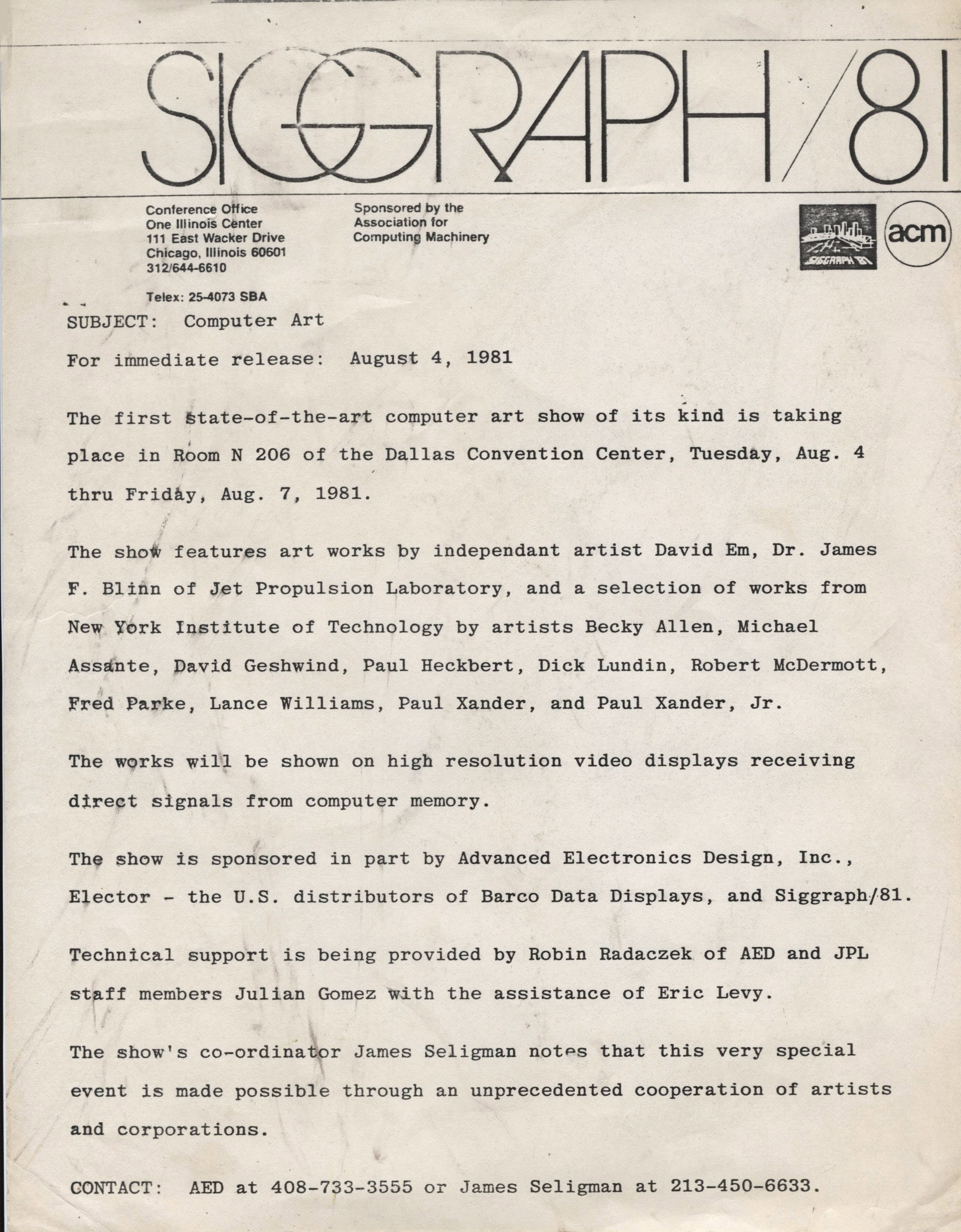
The press release for the 1981 Framebuffer Show, listing the key players involved (https://history.siggraph.org/wp-content/uploads/2018/03/1981_info_pressRelease.jpg).
But, would they be able to produce a show in less than two months, let alone secure the equipment? “It was pretty outrageous,” recalls Blinn, to even conceive of producing such a show. The monitors, framebuffers, and a computer could easily cost hundreds of thousands of dollars (in 1981 money!), and the sensitive equipment would need to be installed in the showroom (and later deinstalled).
Holzman preferred to remain minimally visible in the production of the 1981 Framebuffer Show to prevent it from appearing to be a NASA-sponsored project and to avoid drawing attention from the JPL hierarchy. However, he performed his magic and reached out to his hardware vendor contacts, including the vice president of Advanced Electronic Design (AED), Jerry Kennedy, who agreed to provide much of the hardware used in the exhibition.
In preparation for the show, Blinn told the NYIT contributors that they should submit their images on 9-track tapes (around 45–175 MB per tape). At the time, standard file formats, such as JPEG and TIFF, did not exist, nor did color spaces, let alone image compression.
AED’s technical support assistant, Robin Radaczek, ensured that all the equipment was ready for the show on schedule, including six AED 512 8-bit framebuffers. It is unclear who arranged for six Conrac CRT (Cathode Ray Tube) monitors and, not least, a Digital Equipment Corporation (DEC) PDP-11 computer that drove the AED framebuffers and the Conrac monitors. The 1981 Framebuffer Show now had well over $200,000 (around $750,000 in 2026 money) in computing and display hardware at its disposal.
Julian Gomez had just returned to JPL after the spring quarter ended at Ohio State University when Holzman tasked him with preparing the installation and assembly of the show in Dallas. Blinn and Em had already decided which of their images to include and were awaiting NYIT’s contributions—once the artworks from the NYIT arrived, Blinn discovered he had to spend considerable time converting the files’ brightness and color settings to prepare them for the exhibition.
Gomez recalls that he developed the image display software in FORTRAN IV PLUS code in record time. He arranged the AEDs to cycle the image files across the six screens, displaying them in random order to provide a dynamic viewing experience.
The 1981 Framebuffer Show was scheduled to open at 10:00 A.M. on the Tuesday of the conference week, and Gomez planned to fly to Dallas Sunday evening with the tape of the images for the exhibition. He had spent the past six weeks prepping the final tape and writing the script for the software to be used at the show.
Blinn and Em had already left for Dallas, but Gomez stayed back at JPL because getting the master tape right was no trivial matter. It took hours to write and verify the files, and the magnetic tape technology of that era was incredibly slow. He had to postpone his trip three times before finally boarding an early Monday morning flight at 2:00 A.M. from LAX to Dallas. Gomez remembers how the tape—the only master tape—did not leave his hands for the entire trip. They were cutting it pretty close with only about 24 hours to go until showtime.
When Gomez arrived at the Dallas Convention Center on Monday morning, all the hardware was already in place, ready to be booted and the software installed. Everything went smoothly until the images got loaded. “They all looked like garbage,” Gomez said, recalling his horror at seeing corrupted images on the monitor.
Scrambling to fix the issue they called Eric Levy, who had stayed at the JPL Graphics Lab. Levy poked around and discovered that the RSX-11 Operating System (Real-Time System Executive) running on the Graphics Lab’s PDP-11 was inserting words into certain parts of the binary data, which appeared as an error code and corrupted the values of the raw image files. Thankfully, Levy’s discovery allowed Gomez and Blinn to modify the software to skip over the flawed data—and Hallelujah—the images appeared correctly.
Gomez and Blinn had spent all of Monday on this issue, and Gomez returned early Tuesday morning to finish the script for playing the images. He wrapped up just 20 minutes before the doors opened. But, rather than getting some well-deserved rest after nearly 60 hours of non-stop pre-production, Gomez was asked by AED’s Jerry Kennedy to do a presentation on his part in assembling the exhibition.
At 10:00 A.M. on Tuesday, August 4, 1981, the doors opened to the exhibition in Room N 206 at the Dallas Convention Center; it ran through Friday, August 7th. Em recalls being surprised when he arrived early in the morning and found a long line of people waiting to get in to see the show. In addition to the press release, the only promotion for the 1981 Framebuffer Show was some signs James Seligman had hastily printed and put up in the hallways of the Convention Center.
When the audience entered the dimly lit room, they encountered the artworks displayed across six Conrac monitors raised to eye level. The PDP-11 computer and the AED framebuffers were concealed behind a curtain. The software Gomez had written enabled each of the six Conracs to cycle through the digital artworks by Blinn, Em, and NYIT every 5–10 minutes.
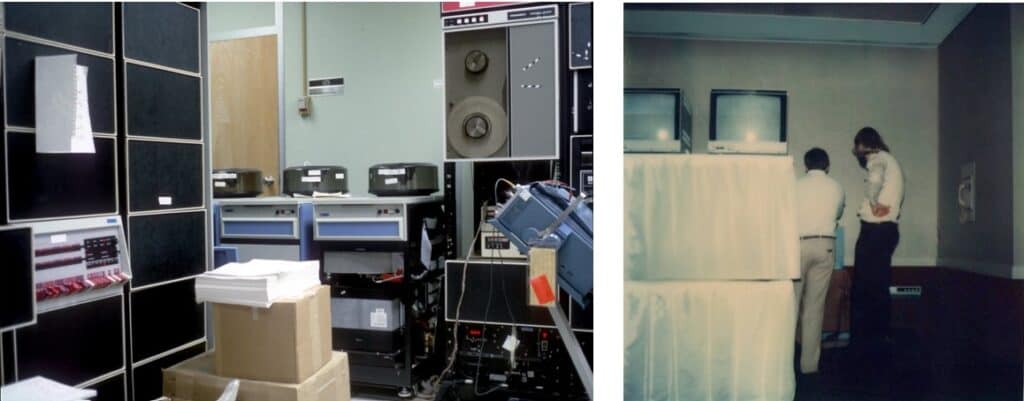
Left image: the PDP-11 in the Graphics Lab at JPL, on which the mag tapes for the exhibition were generated. Right image: Julian Gomez (left) and Jim Blinn in the 1981 Framebuffer Show exhibition room, with the Conrac monitors in the foreground. Photo courtesy of David Em.
A full list of the images included in the exhibition remains incomplete. The master magnetic tape may still be recoverable; however, recovering data from mag tapes from this era has proven difficult. Gomez, who has since founded the Computer Graphics History Institute, is working on recovering the files to provide a complete record of the groundbreaking exhibition.[3]
Based on the principals’ recollections, a partial reconstruction of the images in the exhibition is included below. Blinn’s images were contemporaneous with the Voyager I and II flybys of Saturn and Jupiter. They demonstrate his cutting-edge software, creating scientifically accurate texture mapping, transparency effects (e.g., the rings of Saturn), and cast shadows, as well as his work for Carl Sagan’s Cosmos television series.
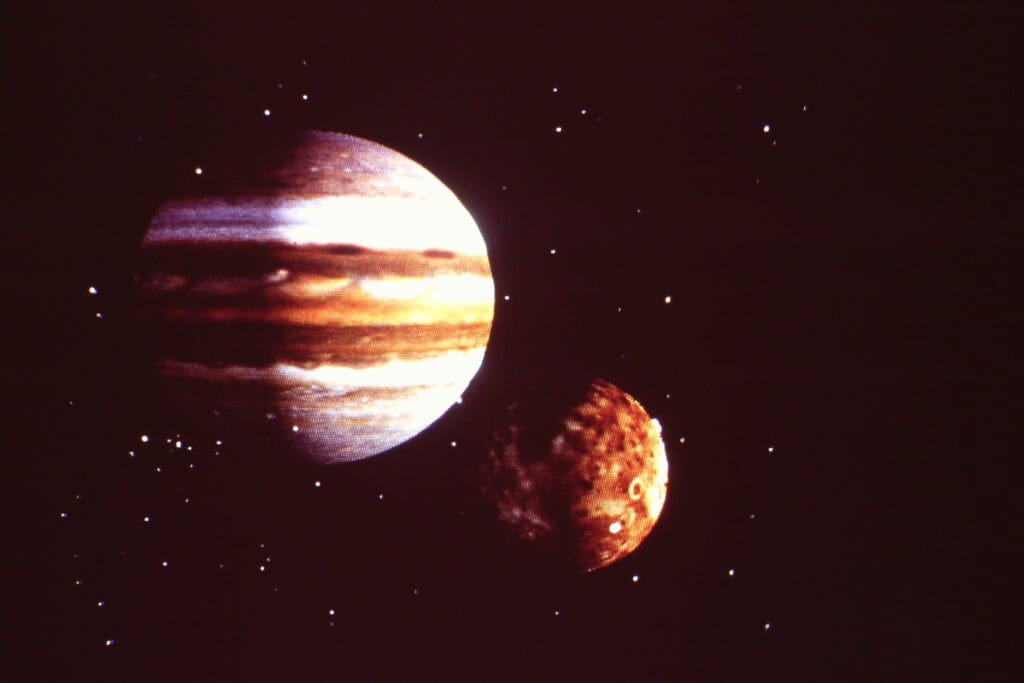
Simulation by Jim Blinn created in the Graphics Lab at JPL of Jupiter and its moon Io (1981). Image courtesy of NASA/JPL.
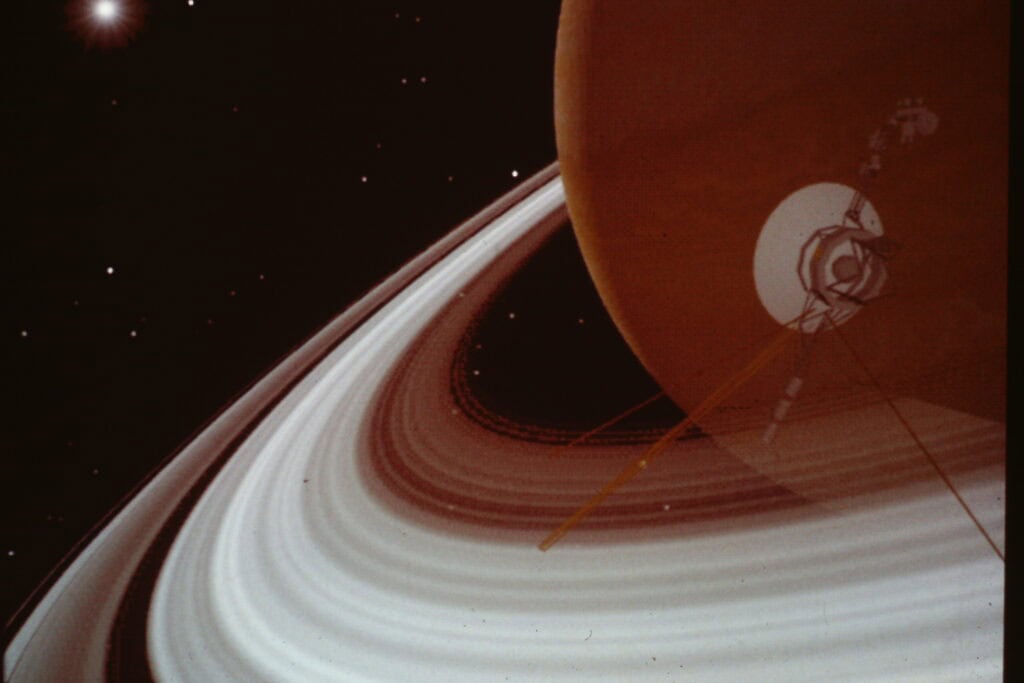
Simulation by Jim Blinn created in the Graphics Lab at JPL of Voyager II flyby of Saturn (1981). Image courtesy of NASA/JPL.
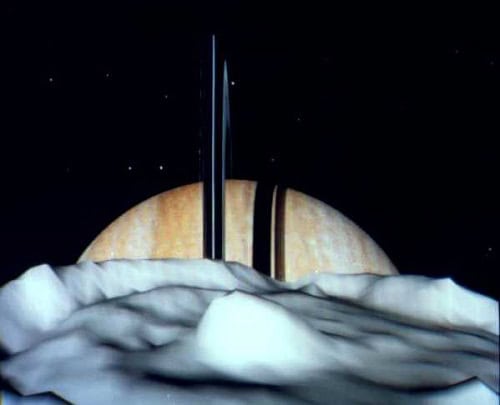
Simulation by Jim Blinn created in the Graphics Lab at JPL of Saturn and its moon Mimas (1981). Image courtesy of NASA/JPL.
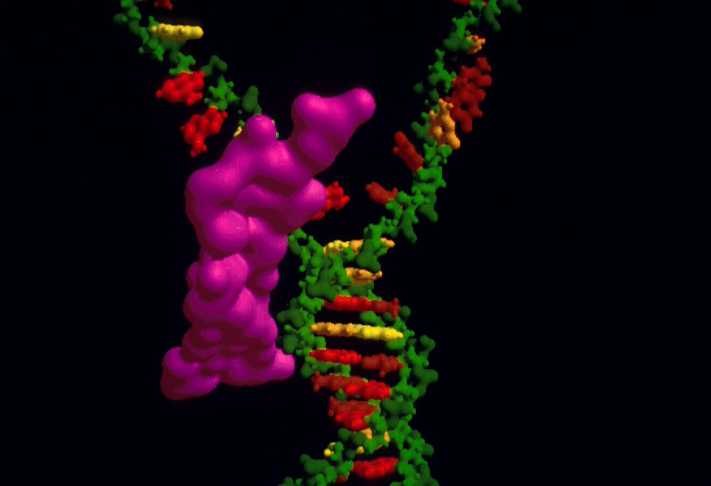
Simulation by Jim Blinn created in the Graphics Lab at JPL of DNA simulation for PBS Cosmos series (1981). Image © 2006 Druyan-Sagan Associates, Inc.
Em’s artwork reflected his growing involvement with navigable virtual worlds inspired by the deep-space environment in which he was immersed at JPL, and integrated surreal and dreamscape elements. While his images had previously been published and exhibited in print form, presenting them to the public in their original electronic context was a fundamentally different experience.
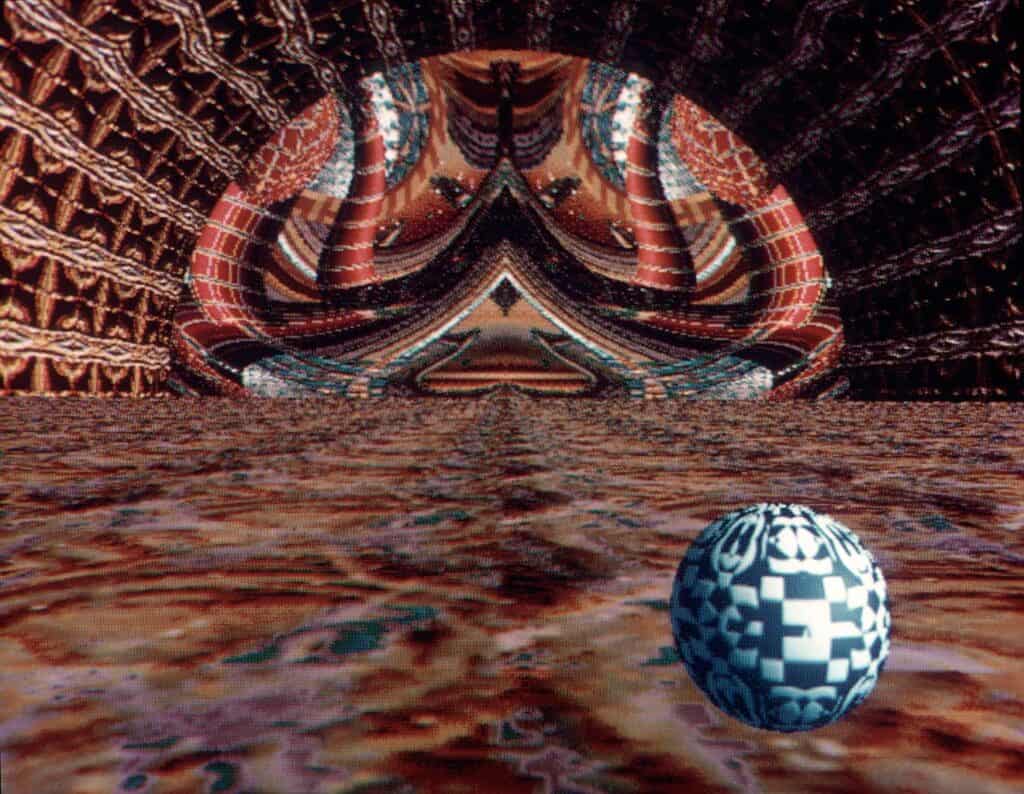
Artwork by David Em © created at JPL using Jim Blinn’s software, Persepol (1980). Image courtesy of David Em.
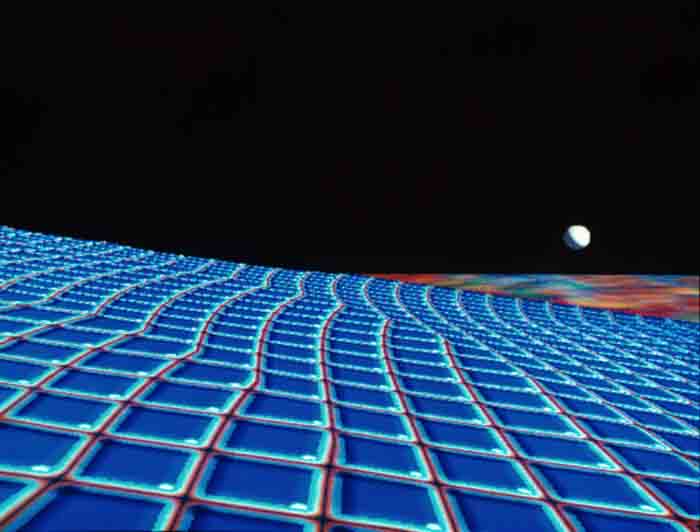
Artwork by David Em © created at JPL using Jim Blinn’s software, Approach (1979). Courtesy of David Em.
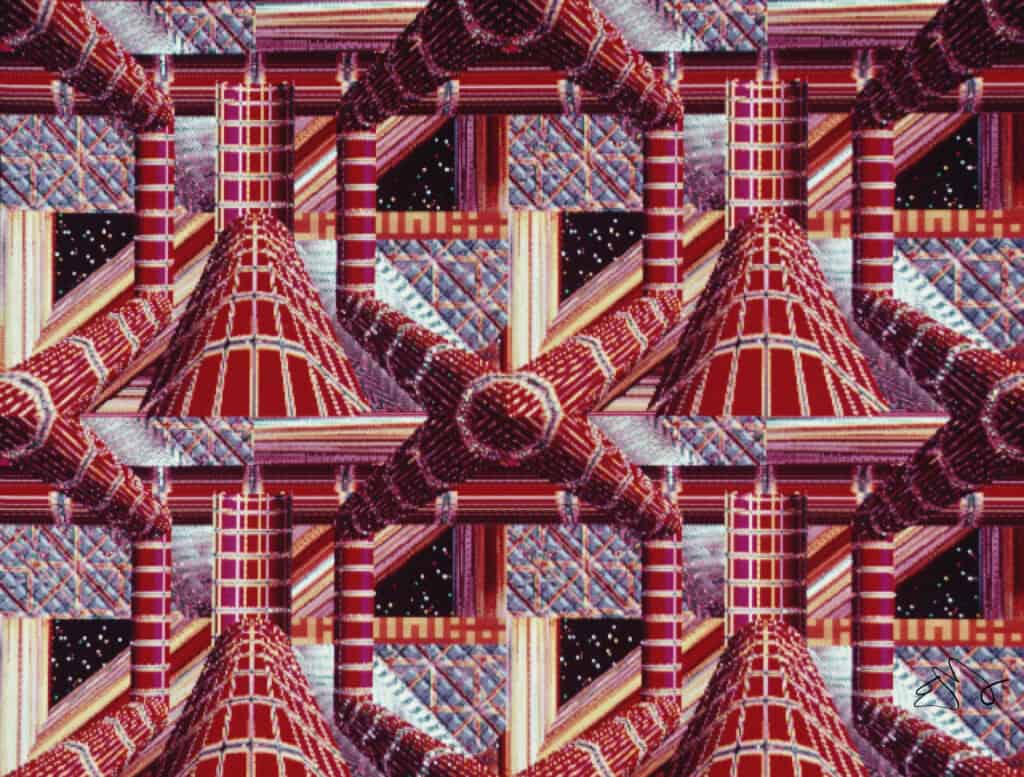
Artwork by David Em © created at JPL using Jim Blinn’s software, Escher (1979). Image courtesy of David Em.
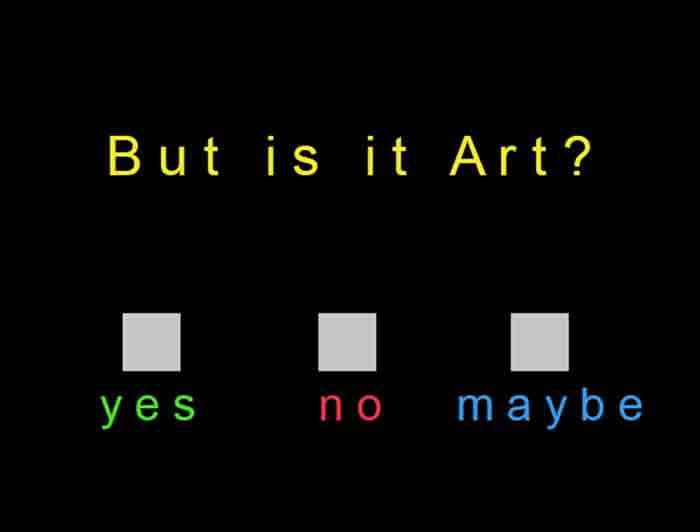
Artwork by David Em © created at JPL using Jim Blinn’s software, But is it Art? (1981), an image created specifically for the exhibition, as Em repeatedly encountered people who questioned whether digital art was true art. Image courtesy of David Em.
Except for the artwork Swimmer (1981)[4] by Rebecca Allen, reconstructing a complete list of what was included from NYIT has not yet proven possible. Computer scientists Lance Williams and Dick Lundin may have contributed an 8-bit still image of their ant character from a film they were working on at NYIT, called The Works [5]; artist Paul Xander, who created 2D paintings using paint software written by Alvy Ray Smith, may have submitted The Desert Landscape; and computer scientists Fred Parke and Robert McDermott possibly included an image of the human body. Based on the known contributors from the press release and discussions with former NYIT employees, the images below are valid candidates.
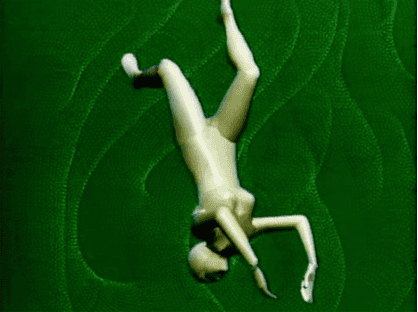
Swimmer (1981) by Rebecca Allen. Image courtesy of New York Institute of Technology.
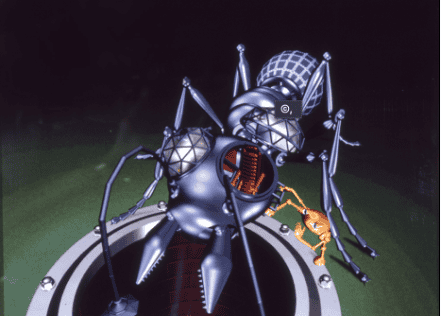
Robot Ant with Ipso (1981). Image courtesy of New York Institute of Technology.
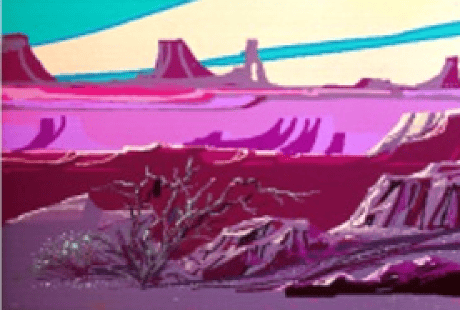
The Desert Landscape (1975) by Paul Xander. Image courtesy of New York Institute of Technology.
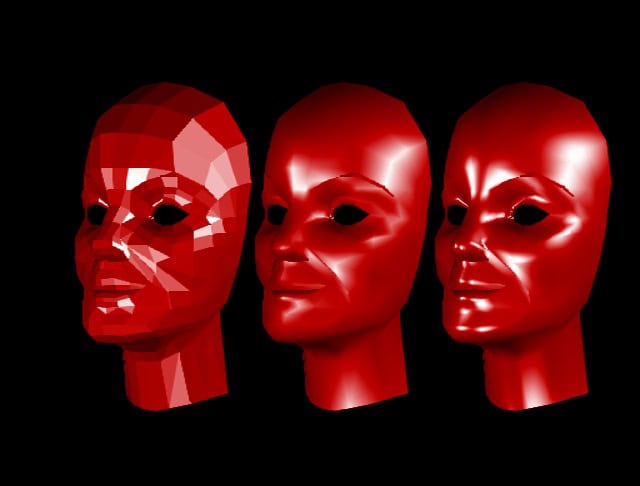
Faces (1981) by Fred Parke and Paul Heckbert. Image courtesy of New York Institute of Technology.
The historic 1981 Framebuffer Show fundamentally changed how digital images and art are displayed today; however, it would still be several years before fully digital exhibitions became mainstream in museums and other public settings, such as Times Square in NYC and the Sphere in Las Vegas. The 1981 Framebuffers Show is a prime example of how collaboration between visionaries can manifest something “outrageous.”
This account has been made possible through invaluable conversations with David Em, Jim Blinn, and Julian Gomez, which have helped ensure that the accounts of what transpired at JPL Graphics Lab and the 1981 Framebuffer Show are as accurate as possible. Alvy Ray Smith and Amber Denker were important sources in clarifying the history of the NYIT contributors’ involvement.
1.) Simulation film of NASA’s Voyager II’s encounter with Jupiter by Jim Blinn from 1978 https://youtu.be/o4xIJlEV8Kw?si=i40JclYq-MTIjKeE
2.) Jim Blinn’s presentation on how he created the planets for the simulations disseminated by JPL https://www.dropbox.com/scl/fi/zvmx5h03xjur6mq6iig5c/How-to-Make-a-Planet-Narration-Good-V3-640x480.mp4?rlkey=atatsxkaldf10req5dplp9v37&e=2&st=bj2v5g6b&dl=0
3.) Julian Gomez has founded the Computer Graphics History Institute to help preserve narratives like this about the 1981 Framebuffer Show https://www.computergraphicshistory.org/
4.) Rebecca Allen’s Swimmer https://history.siggraph.org/artwork/rebecca-allen-swimmer/
5.) Lance Williams and Dick Lundin’s Robot Ant with Ipso https://history.siggraph.org/artwork/dick-lundin-lance-williams-robot-ant-with-ipso/