This year Apple celebrates its 50th anniversary. Over the last 50 years, the iconic company has evolved through various phases: its founding in the garage; explosive growth with the Apple II; the debut of the Macintosh; the John Sculley, Michael Spindler, and Gil Amelio regimes; Steve Jobs’ return to save the company; the revolution of the iPhone and iPad; the current Tim Cook era.
At CHM, we’re celebrating Apple with an exhibit of rare prototypes from across Apple’s eras. Three are highlighted below.
The Apple I, designed and built by Steve Wozniak as a hobby, started it all. After showing it off at the Homebrew Computer Club, Woz and Jobs were approached by Paul Terrell, the owner of the Byte Shop, the first chain of microcomputer retail stores in the Bay Area. Terrell’s order of 50 assembled Apple Is galvanized the Steves to start Apple. These first machines didn’t come with a case, so Jobs negotiated with local cabinet maker Charles Pfister Sr. and his son Chas, who knew Jobs as a teenager, to supply walnut wood cases to Apple I customers. On display is the original prototype case, made of birch and maple, designed and built by Chas.
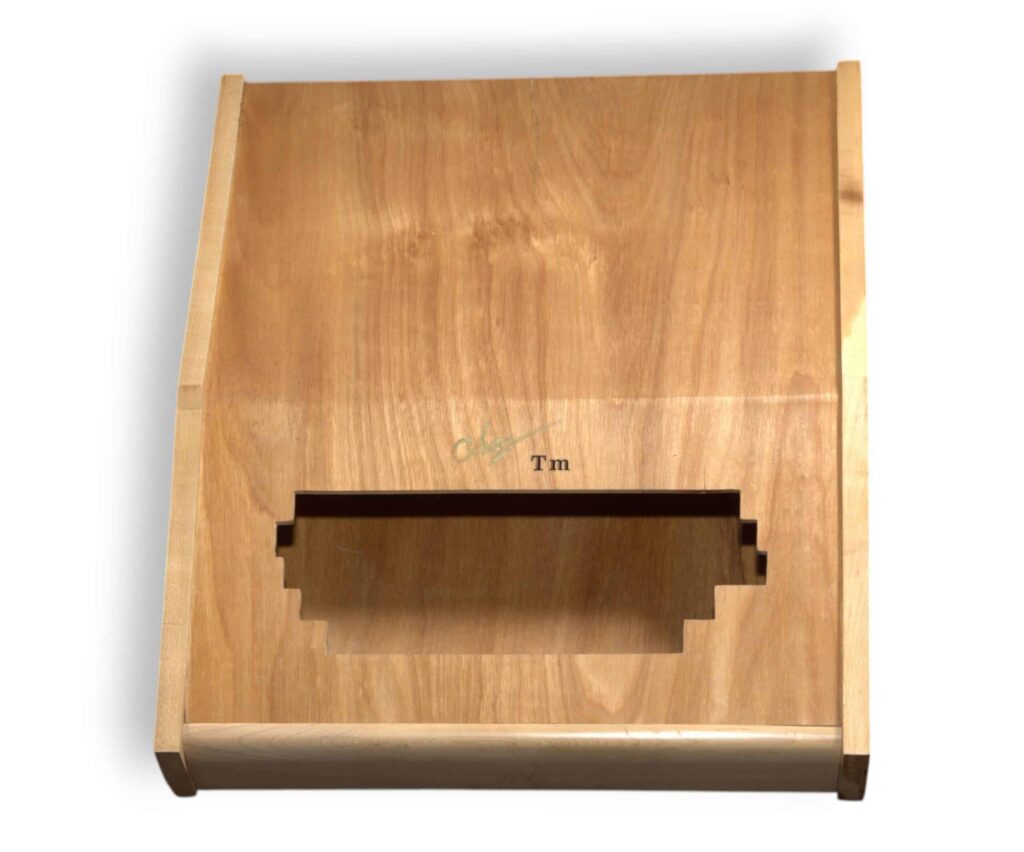
Prototype Apple I birch and maple wood case, designed and built by Charles “Chas” Pfister. While Chas signed his name on the prototype, Steve Jobs did not want it on the final version. Loan of Charles Pfister, #L001.2025.01.
Byte Shop owner Paul Terrell discusses his order of 50 Apple I computers, spurring Jobs and Woz to start Apple.
Released January 24, 1984, the Macintosh brought the mouse-driven graphical user interface to a consumer desktop. While today all PCs work this way, this was revolutionary to most people in 1984.
On display at CHM are two notable Macintosh prototypes. One is a wire-wrapped board, made in June 1981 by Brian Howard and Daniel Kottke. Wire-wraps are hand-wired breadboards, assembled individually or in small batches at an early stage of development when engineers need to be able to change things quickly. Only when a design is locked down are printed circuit boards, which can’t easily be changed but allow for large production runs, made.
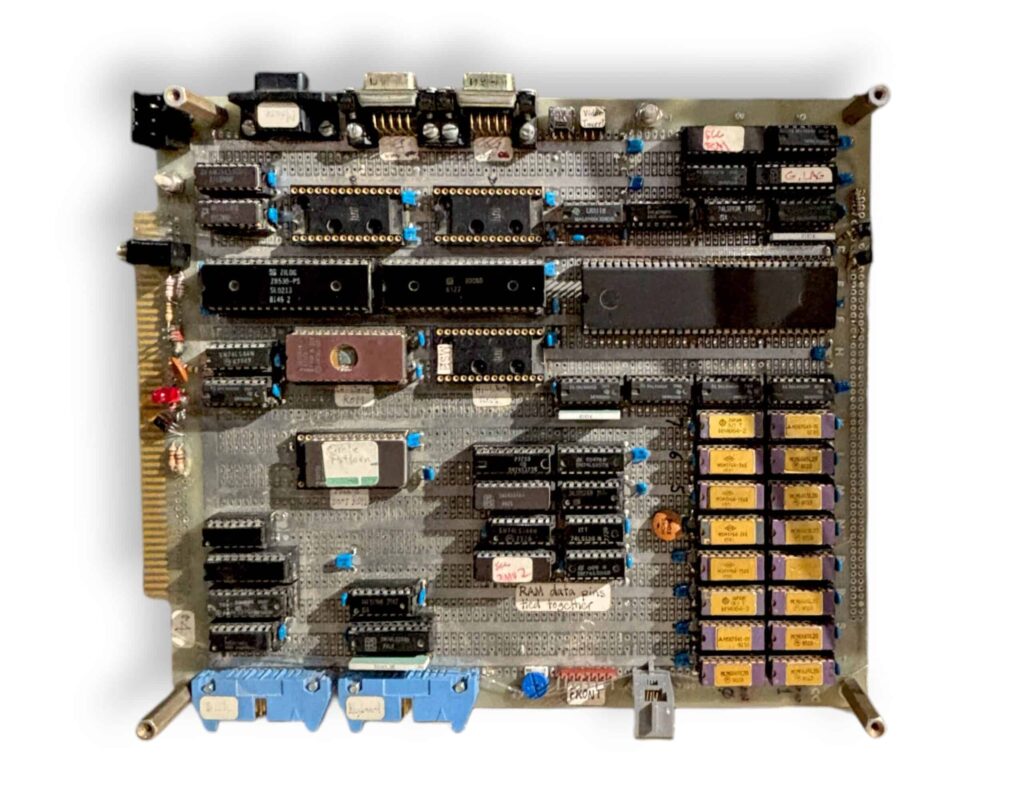
Macintosh wirewrap prototype #4, 1981. Gift of Andy Hertzfeld, 102638251.
The second prototype is a Macintosh in a transparent acrylic case, made circa December 1981, also by Howard and Kottke. This may have been the first prototype to show approximately what the final case design, designed by Jerry Manock and Terry Oyama, would look like. It would have been given to software developers, inside and outside Apple, to let them start writing apps for the Mac.
Notably, at this early stage, this prototype still uses an Apple II power supply and floppy disk drive. The decision to use Sony’s 3.5” floppy drive wouldn’t be made until 1983, and is associated with a funny story where Macintosh engineers had to ask a visitor from Sony Japan to hide from Steve Jobs in a closet!
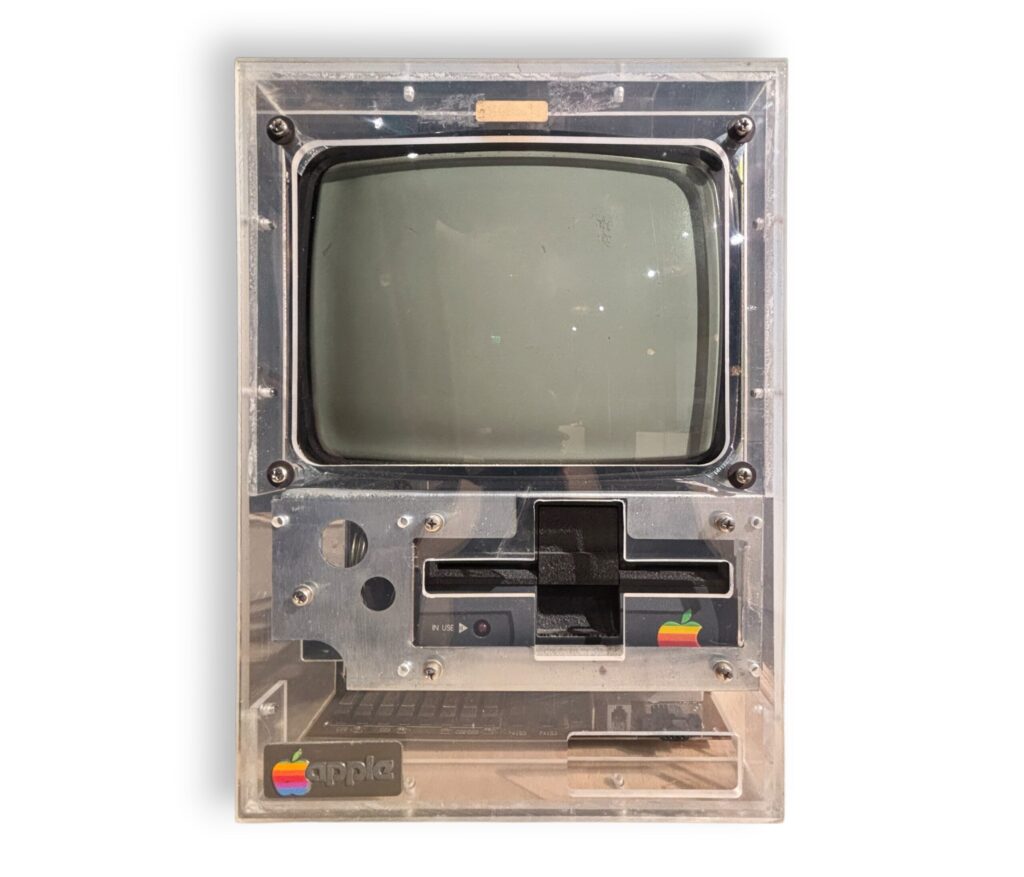
Macintosh Prototype in Acrylic Case, 1981. Gift of HSC Electronic Supply, 102717968.
After winning a power struggle with Steve Jobs in 1985, CEO John Sculley managed to turn Apple around and lead it into the Macintosh’s first golden age in the late 1980s, powered by the desktop publishing revolution. Sculley began to look to Apple’s future, towards mobile computing devices. Apple’s first mobile device was the Newton MessagePad, the first of a new category Sculley dubbed “personal digital assistants” or PDAs.
What may not be well-known is that the Newton began as a tablet-sized device, code-named “Cadillac.” But marketer Michael Tchao managed to convince Sculley that a smaller, cheaper, and less ambitious device was needed. Sculley green-lit the Newton “Junior” so long as it would fit in a man’s shirt pocket. Cadillac and Junior were developed in parallel for a time, but ultimately Cadillac was cancelled, and only Junior shipped. On display are prototypes of both products.
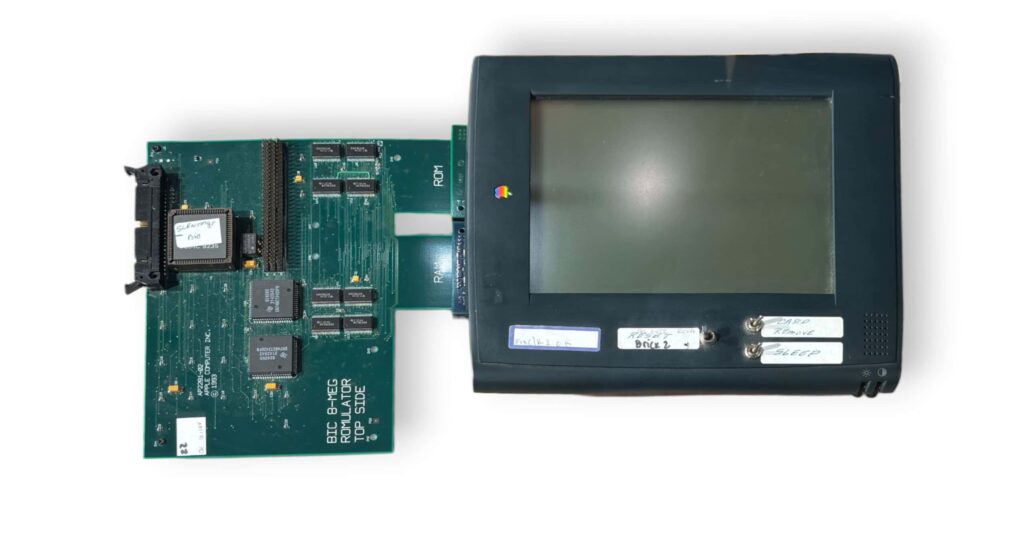
Newton Cadillac Engineering Prototype, ca. 1994. Gift of Steve Capps, 102633650.
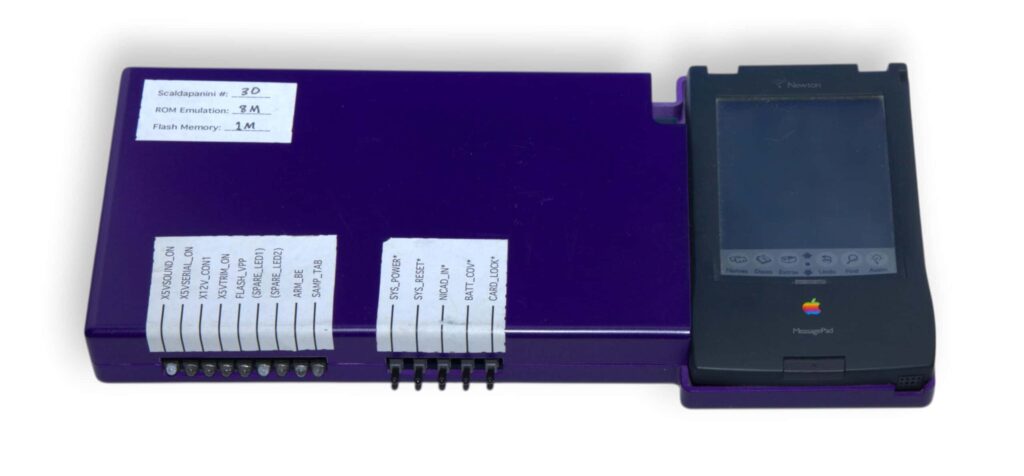
Newton MessagePad Prototype, ca. 1995. Gift of Steve Capps, 102633644.
Famously, Newton’s launch was a disaster. Sculley had preannounced the Newton in January 1992, but its release was delayed until August 1993. Worse, the device’s promised handwriting recognition barely worked, famously lampooned in the comic strip Doonesbury. Combined with a disastrous June quarter and other factors, Sculley’s association with the Newton contributed to his firing by the Apple board. Subsequent updates would fix most of the Newton’s original issues, but it never became the wave of the future as Sculley had envisioned, and it would be killed by Steve Jobs upon his return to Apple in 1997.
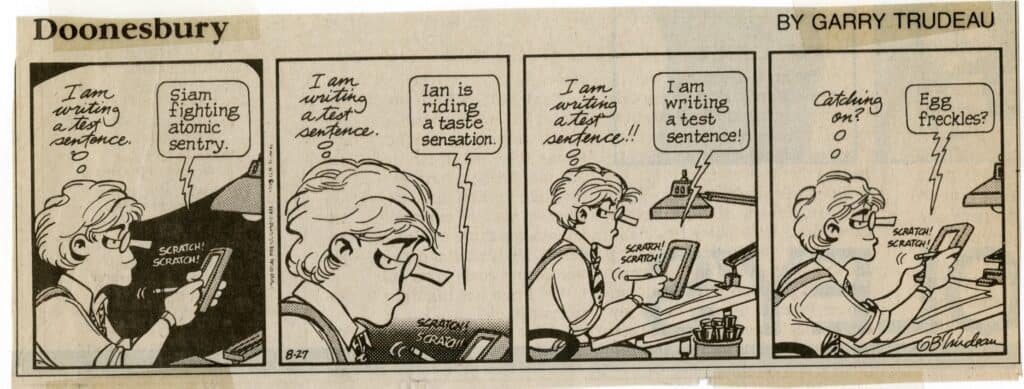
Doonesbury comic strip by Garry Trudeau, © Universal Press Syndicate, 500004918.
But Newton would plant the seeds of Apple’s future success in mobile computing. To make the Newton’s CPU, Apple co-created ARM, a joint venture with chip maker VLSI and British PC maker Acorn, with Apple owning a 43% stake. To keep Apple financially afloat in 1997, Apple sold most of its ARM shares. Thus, Apple’s ARM investment literally saved the company from bankruptcy. And when Apple began to make mobile devices again, like the iPod, iPhone, and iPad, it would use ARM chips.
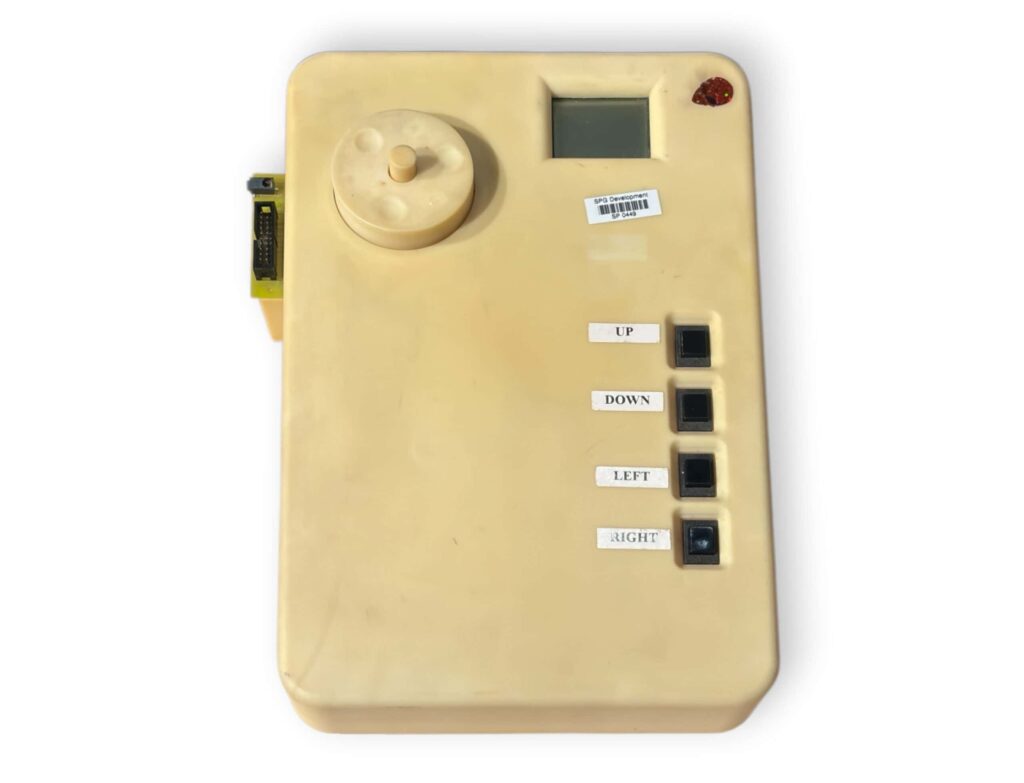
iPod Prototype, ca. 2001. Gift of Shannon Wells, 102807216.
The iPhone transformed both Apple and the computer industry, making a reality the mobile-centric world that Sculley could only dream about in the 1990s. Today, Apple-designed ARM chips even power the Mac itself, enabling Macs to be both powerful yet energy efficient. What might have been Apple’s biggest failure may have sowed the seeds to its greatest success.
Stop by the Museum to see the exhibit through September 7, 2026, and check out an audio tour of highlights (in three languages!) here.